
When I talk with independent artists about money, the same pattern shows up almost every time. They have one stream that does most of the work, usually gigs. Everything else is either missing, half-built, or happening by accident.
That works until it doesn’t. A venue closes. A tour falls through. A slow season stretches out longer than expected. When one stream carries your whole income, every problem with that stream becomes a problem with your whole career.
I have been a musician for more than 30 years, and I coach artists on how to run their music like the business it is. This article lays out the framework I use: four streams, built in a specific order, organized so you can see what is working. If you read my earlier article on the 5 mistakes keeping talented musicians broke, this is the long answer to Mistake 2: relying on a single revenue stream.

How I Think About This: Build, Organize, Run
Before the four streams, here is the approach behind them. Every artist I work with goes through the same three steps.
Build. Add one stream at a time. Not five new ideas this month. One stream, built well enough to produce real income before you start the next.
Organize. Give every dollar a place to land and a label that says where it came from. If you cannot say how much each stream made last quarter, you cannot decide where to spend your time.
Run. Review the numbers on a schedule. A 30-minute monthly money review does more for most artists than another month of working harder.
Everything below follows that order.
The Foundation Under All Four Streams
Two things need to exist before any stream can work well. Both are small, and both are boring, which is why most artists skip them.
1. A money system. Open a separate checking account for music income and expenses, even if it starts at zero. Then keep a simple tracker with five columns: date, stream, source, amount, and what it cost you to earn it. I will show a sample later in this article. You can also use the system I share in my video. Without this, you will guess at your profit for years.
2. An owned audience. Every stream gets stronger when you can reach your fans directly. Social platforms can change their reach, rules, or existence overnight. An email list belongs to you. Collect addresses at shows, on your website, and through every release, and keep that list in a system you control, not just in an app that could vanish. You can also collect phone numbers and get permission to send text messages (SMS) as well.
I put these first because they are what turn four separate income sources into one business. The tracker shows you what is working. The list gives you a way to sell to people who already like you.
Stream 1: Live Performance
What it is: Money you earn for playing music in front of people. Club and bar gigs, private events, festivals, house concerts, corporate shows, and touring all belong here.
Why it matters: For most artists, this is the stream that already exists. It also builds the relationships that feed every other stream, since fans meet you in the room and then follow you online, join your list, and buy your merch.
How to build it well:
Most artists grow this stream by playing more shows. A better move is to improve what each show pays and who each show reaches.
- Raise your rate before you add dates. Underpricing is the quiet leak in this stream. One of my clients used to be afraid of asking too much. Now he will not leave the house for less than $500, and his full original band recently quoted $4,000 for a private birthday party and landed it. His talent did not change. His willingness to name a number did.
- Add higher-paying formats. Private events, corporate bookings, and house concerts often pay more per night than a standard bar gig, and they put you in front of people who came to listen.
- Treat every show as a list-building event. A show with no way to capture contact information is a show that ends when the music does.
- Think from the venue’s side. Venues book artists who make their night easier: a reliable draw, clear communication, and a pitch that explains what the room gets out of the deal.
How to organize it: Track every gig with four numbers: what you were paid, what you spent to get there and play, how many email addresses you collected, and how many hours the whole thing took. Within a few months you will know which kinds of shows are worth your time.
Common mistake: Counting the check instead of the profit. A $300 gig that costs $120 in gas, gear, and sound fees, and eats a full day, is a very different gig from a $300 gig down the road.
Quick start this week:
- Look up the last five gigs you played and calculate real profit on each
- Pick the lowest-profit type of show and decide whether to raise the price or stop booking it
- Add a list sign-up method to your next show, even a simple QR code
Stream 2: Recorded Music and Rights
What it is: Money your recordings and songs earn when other people use them. Streaming payouts, downloads, sales of your releases, performance royalties, mechanical royalties, and sync licensing for film, TV, ads, and games all live here.
Why it matters: This stream can earn while you sleep. It is also the slowest to build, which is exactly why it needs attention early. You cannot collect money you never set up to collect.
The rights pieces most artists miss:
Your music can earn several different kinds of royalties, and each one is collected by a different organization. A few that matter for many independent artists:
- Your distributor pays you for streams and downloads of your recordings, and every distributor has its own fees and terms.
- A performing rights organization (PRO) such as ASCAP or BMI collects performance royalties for songwriters and publishers when songs are played publicly, on radio, or in venues.
- SoundExchange collects digital performance royalties for sound recordings played on satellite radio, internet radio, and similar services.
- The MLC collects mechanical royalties in the United States for songwriters and publishers when songs are streamed or downloaded on interactive services.
- Sync licensing places your music in video, film, and advertising, and is usually handled directly or through a licensing company.
You do not need to master all of this on day one. You do need to know which of these you have registered for and which you have not, because unregistered music can leave money uncollected.
How to build it well:
- Do the registrations in your first month. They are mostly free, take an afternoon or two, and keep paying off long after you finish them.
- Use split sheets before every recording session. Agree on who owns what while everyone is still friends. This one piece of paper prevents most rights disputes.
- Choose your distributor on purpose. Compare fees, payout terms, and what you keep. Staying with your current one is fine, as long as it is a choice and not a default.
- Release on a rhythm you can sustain. Consistent releases keep your catalog earning and give you a reason to talk to your list.
How to organize it: Keep a simple rights log with each song, who wrote it, the split agreed on, and where it is registered. Add the date you last checked each statement. If you ever get a sync request, this log saves you days.
Common mistake: Expecting streaming alone to carry the whole stream. For most independent artists, streaming works better as a way to build an audience than as a main paycheck. Rights, licensing, and sales of your music do more of the earning when they are set up correctly.
Quick start this week:
- List every song you have released and mark where each one is registered
- Register anywhere you are missing, starting with the free options
- Draft a split sheet template you can reuse before every session
Stream 3: Direct-to-Fan Sales
What it is: Money fans pay you directly, with no platform setting the price. Merch, physical media such as vinyl and CDs, digital downloads, memberships, paid subscriptions, tickets to your own events, and limited editions all belong here.
Why it matters: This stream has the highest margin and the most control. A fan who pays you directly is also a fan whose email address you can capture, which makes this the stream that rewards the owned audience we talked about in the foundation.
How to build it well:
- Start with the fans you already have. Your best 50 to 100 fans are worth more than 10,000 people who scroll past you. Ask them what they would buy.
- Make merch fit your story. Products that say something about who you are sell better than generic shirts with a logo. Offer a small number of items, priced with real margin built in.
- Add a recurring option. A small monthly membership, with something real behind it such as early listens, behind-the-scenes content, or a private chat, turns fans into steady income instead of one-time sales.
- Design the table, not just the product. At live shows, a clean setup, clear prices, and an easy way to pay lift sales more than adding new items does. You can find additional ideas and more detail on my merch table video.
- Treat your best fans like your best fans. Someone who buys twice deserves more attention than someone who followed you once.
How to organize it: Track every direct sale by product and by channel: at the show, online, or by membership. Record your cost for each item, so you can see actual margin. Note which fans buy repeatedly, because those people are your core audience.
Common mistake: Ordering inventory before testing demand. Presell a limited run to your list first, then order based on real interest. You will waste far less money.
Quick start this week:
- Name your 10 most engaged fans and message each of them personally
- Choose one product or offer to test with your list this month
- Calculate your real margin on your current best-selling item
Stream 4: Skills and Services
What it is: Money you earn by applying your musical skills to someone else’s needs. Lessons, workshops, session work, production, mixing, songwriting for others, composing for video, coaching, and paid collaborations all count.
Why it matters: This is the fastest stream to start and the most predictable once it is running. It also tends to be the stream that funds the others, since steady service income gives you room to be patient while rights and fan income grow.
How to build it well:
- Start from what people already ask you for. If other musicians already ask for your advice, your help with recording, or lessons, that demand is a signal.
- Sell a result, not just your time. “Eight weeks to record your first EP” is easier to buy than “an hour of production help.”
- Package and price it. Write down what is included, what it costs, and how someone books you. A clear offer sells itself faster than a vague one.
- Protect your creative time. Set a cap on how many hours a week go to services, so this stream supports your music instead of replacing it.
How to organize it: Track hours alongside dollars. Your effective hourly rate tells you whether a service is worth keeping, raising, or dropping. Record where each client came from, since your best clients usually come from the same one or two places.
Common mistake: Underpricing because the work feels easy to you. A skill you have practiced for years feels simple to you and valuable to someone who does not have it.
Quick start this week:
- List three things people have asked you to help with in the past year
- Pick one and write a one-sentence offer with a price
- Tell five people who might need it
How to Build the Four in Order
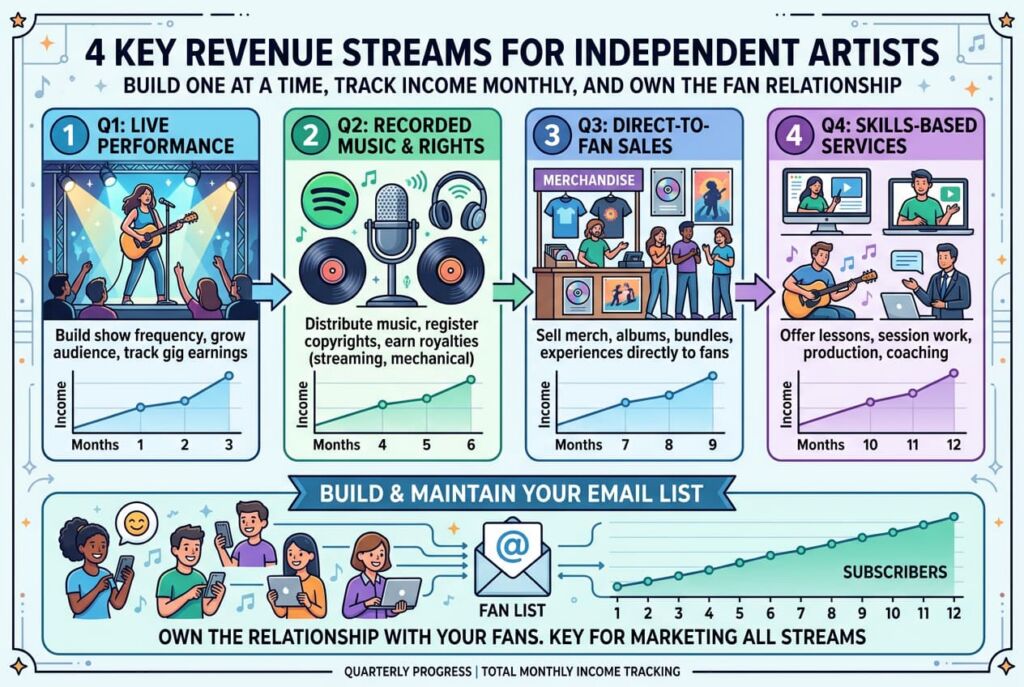
You do not need all four by next month. Here is the sequence I use with artists, one new stream per quarter.
| Quarter | Focus | What You Do |
|---|---|---|
| Q1 | Foundation plus your strongest stream | Open the music account. Start the tracker. Begin collecting emails. Register your music. Improve what your best stream already pays. |
| Q2 | Add your second stream | Choose the stream closest to what you already do. Often that is Skills and Services, since it pays fastest. |
| Q3 | Add your third stream | Usually Direct-to-Fan, since you now have an audience and a list to sell to. |
| Q4 | Add your fourth stream and review | Fill the remaining gap. Review the year by stream and decide where to invest next. |
A note on the order: Do the rights registrations for Stream 2 in the first quarter, even though that stream pays slowest. Registration takes little effort, and income that starts late is better than income that never starts.
Also notice that no step asks you to quit your day job or overhaul your life. The artists I coach build this around jobs, families, and real schedules.
How to Run It: The 30-Minute Monthly Money Review
Once a month, sit down with your tracker and answer five questions.
- How much did each of the four streams earn this month?
- What did each stream cost me to earn that money?
- Which stream grew, and which stalled?
- How many new email subscribers did I add?
- What is the one thing I will do next month to move my weakest stream?
Here is what a simple tracker looks like:
| Date | Stream | Source | Amount | Cost | Notes |
|---|---|---|---|---|---|
| Oct 4 | Live | Private event | $800 | $90 | Booked through a referral |
| Oct 11 | Recorded & Rights | Distributor payout | $64 | $0 | Quarterly statement |
| Oct 18 | Direct-to-Fan | Merch at show | $210 | $85 | 14 shirts sold, 22 emails collected |
| Oct 25 | Skills | Two lessons | $120 | $0 | Same student as last month |
A sheet like this takes a few minutes a week to maintain. After three months, it shows you which streams deserve more of your time, and which ones deserve less.
Key Takeaways
- Most independent artists rely on one income stream. Building four protects your income when any one of them slows down.
- The four streams are live performance, recorded music and rights, direct-to-fan sales, and skills and services.
- Build, organize, and run. Add one stream at a time, label every dollar by source, and review monthly.
- A separate music bank account, a simple tracker, and an owned email list sit underneath all four streams.
- Register your music and set up your rights early, even though that stream pays slowest.
- Add one new stream per quarter, and the four can work together within a year.
Frequently Asked Questions
What are the main ways independent artists make money?
Independent artists earn money from four main sources: live performance, recorded music and rights (streaming, royalties, and licensing), direct-to-fan sales (merch, physical media, and memberships), and skills-based services (lessons, session work, production, and coaching). Most sustainable music careers combine several of these instead of relying on one.
How many income streams should a musician have?
Three to five is a healthy range for most independent artists. Four is a practical target because each stream covers a different risk. Live income can slow down while rights income continues, and service income can stay steady while a release builds momentum.
Which revenue stream should a musician build first?
Start with the stream closest to what you already do. For most artists that means improving live income or launching a simple service offer, since both can produce money quickly. Set up your rights registrations at the same time, because they cost little and pay off later.
How long does it take to build a new music income stream?
In my experience, plan on about 90 days to set up and test a new stream, and longer before it produces steady income. That is why I recommend adding one stream per quarter instead of several at once.
Do I need to register with a PRO, SoundExchange, and The MLC?
It depends on what you create and own. Songwriters generally register with a performing rights organization and The MLC, while artists who own sound recordings often register with SoundExchange as well. If you are unsure which apply to you, ask your distributor or a music business professional before you register.
How do I keep track of income from multiple streams?
Open a separate bank account for music and keep a simple tracker with the date, stream, source, amount, and cost of each payment. Review it once a month. That one habit is what shows you which streams are worth growing.
Ready to Build the Business Behind Your Music?
I help artists build, organize, and run their music business, one stream at a time, around the lives they already have. If you want help deciding which stream to build first, or you want a second set of eyes on your numbers, book a free intro call and we will map it out together.
Eleven Music Career Center is built by a musician, for musicians. Everything here is designed to give independent artists the business education the music industry never offered.
I built this tracker around a simple idea I use with every artist I coach: build, organize, and run your music like a business. That starts with knowing where your money actually comes from.
It has four tabs that matter to your music business:
- Income Log: one line for every payment you receive.
- Monthly Summary: income and profit by stream, filled in automatically.
- Monthly Review: a 30-minute check-in once a month.
- Rights Log: where each song is registered and who owns what.


